

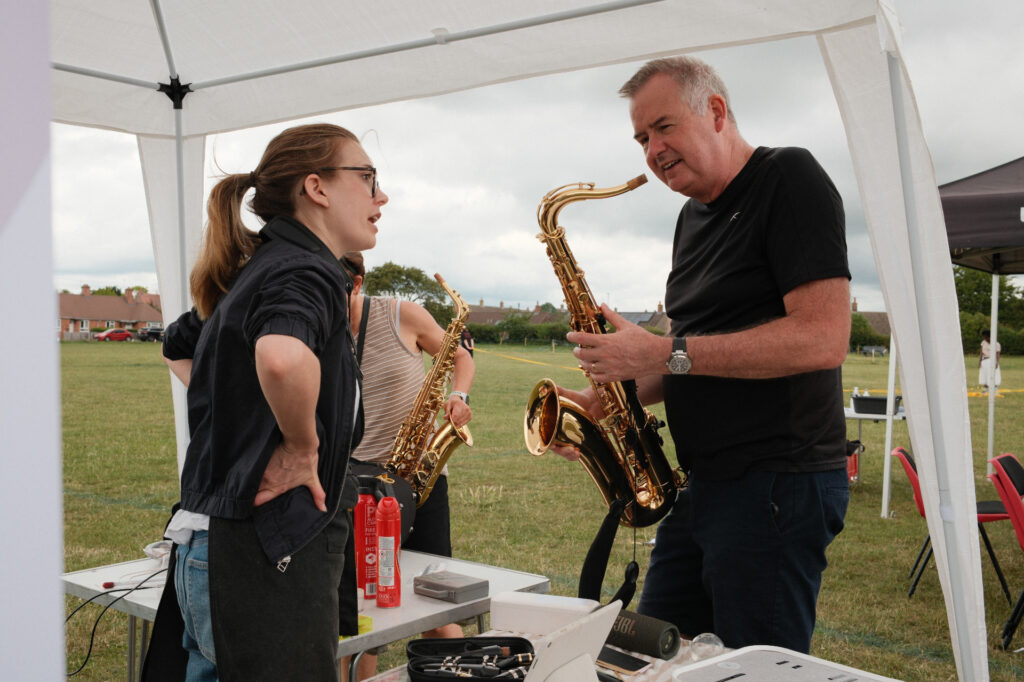
When I first heard that Kevin had bought his tenor saxophone on eBay and was struggling to play it, I got ready to give him some bad news. This usually means the saxophone needs large amounts of repair work, or if you’re very lucky, there’s a specific fault.
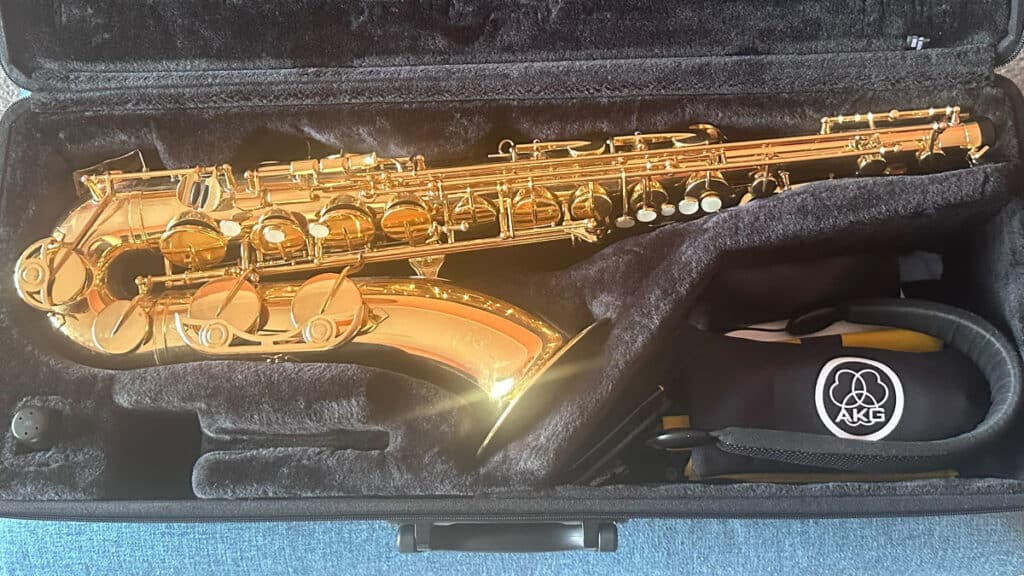
However, it turns out the sax was rather lucky, it was in quite good condition and the principal issue was just a bent crook key. I reported my findings to Kevin and repositioned that one key for a quick fix and he was happy (read about this in Part 1). But, I knew we could get it even better…
The Service
The Tenor saxophone was booked in for a first level service, something I’d recommend saxophones need every 12-18 months – I call it a ‘General Set Up’. This means I don’t fully strip down and rebuild the sax mechanically, but I work with the keys mostly still on the instrument, replacing keycorks and felts, and adjusting pads as needed to ensure the saxophone plays its best.
Pads and Leaks
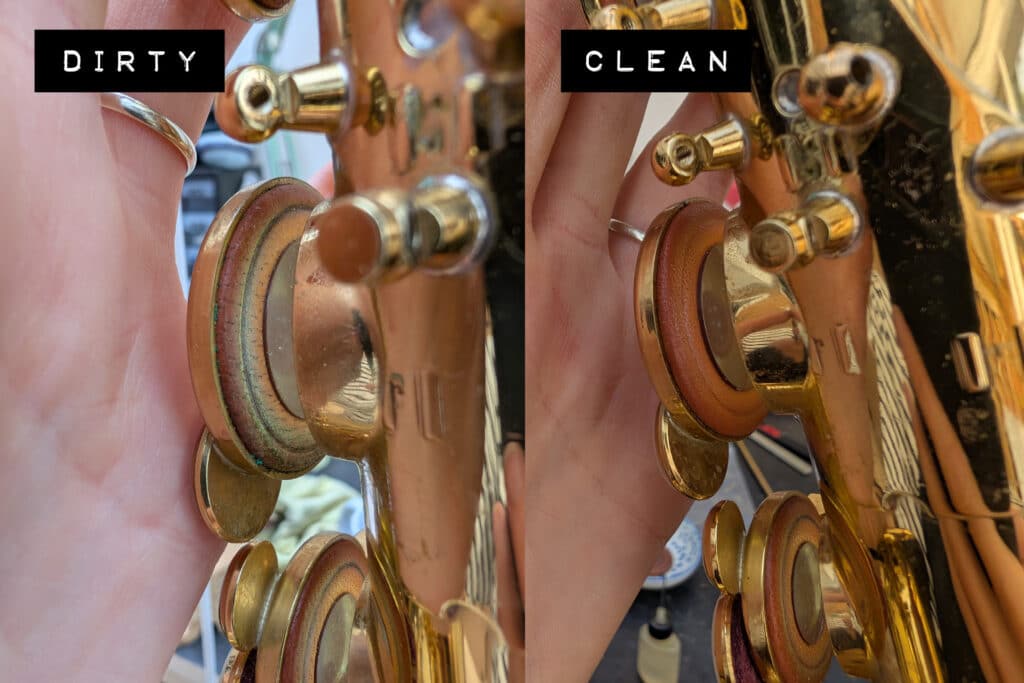
The pads were mostly in decent condition but they were dirty and a few could do with replacing. It had quite a few leaks but none of them were bad enough that it hindered playing. However, these small faults added together causing the sax to sound huskier and more challenging to play, particularly in the low notes.
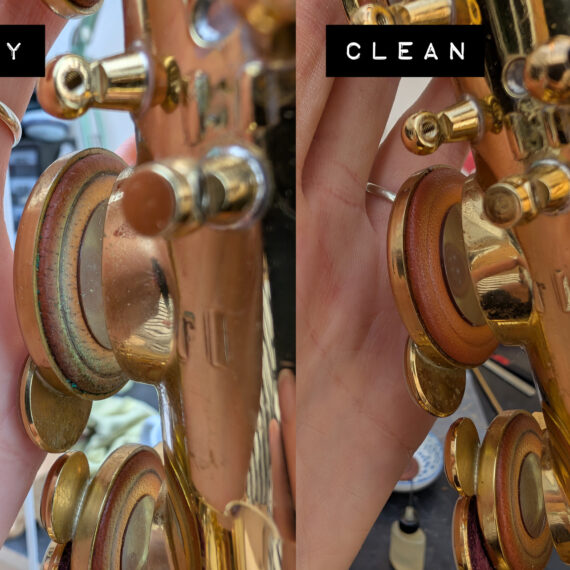
The dirt on sax pads is often a light green. This is because the edge of the tone hole is not lacquered and the copper in the brass alloy reacts with moisture and air to make verdigris, which mixes with dirt and limescale to form a green crust on pads. Luckily it can often be cleaned up.
Pads are glued in with a thermoplastic adhesive. This allows repairers to heat the metal cup, which transfers the heat into the glue behind the pad, causing it to liquify, allowing the repairer to shift the position of the pad ever so slightly to prevent leaks. Leaks happen when moisture and heat from playing and the atmosphere makes the pads warp slightly. Each individual pad should seal well with the lightest touch.
Regulation and Compression
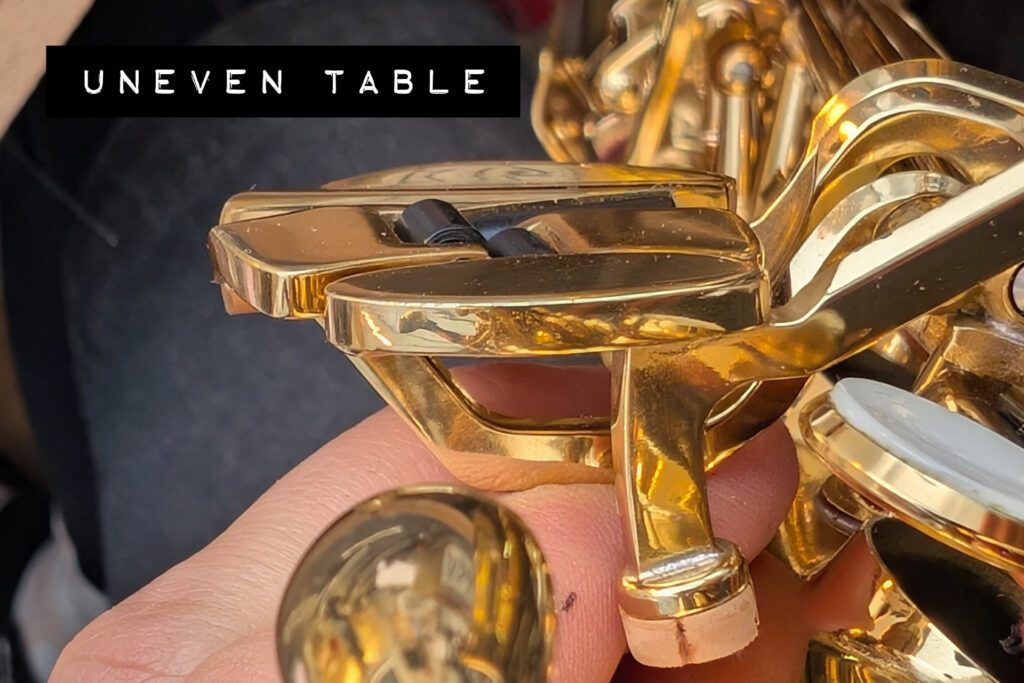
Once each pad seats well, I move onto the regulation, which is simply a fancy way of saying “when one key closes another”. This is done with corks, felts and small regulation screws. Sometimes we have to change materials due to compression, like this felt on the Low C# lever.
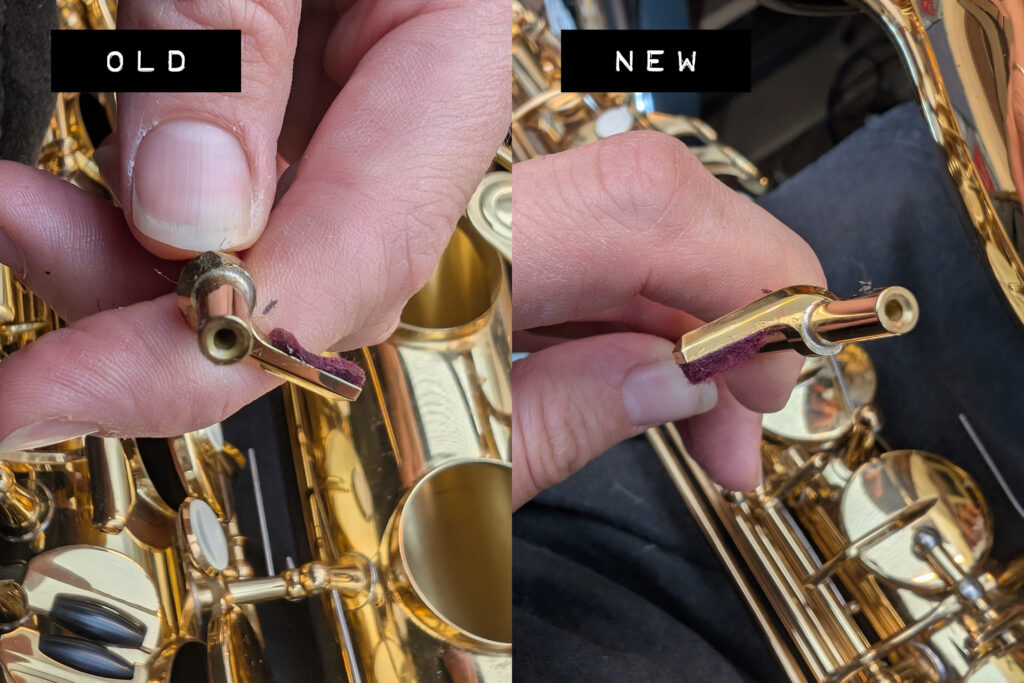
Over time materials wear and compress and issues creep in, like the Low C# keysitting noticeably higher than the surrounding table keys. Once the felt was renewed the keys are more even and the player will be able to reach those bottom notes with greater ease.
Dust
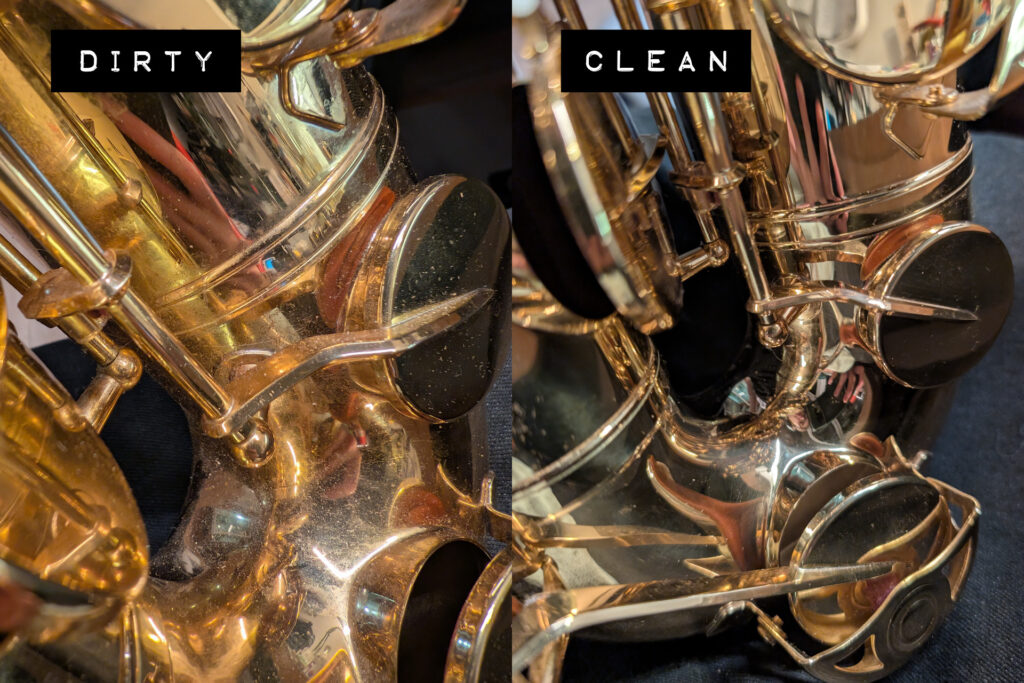
The sax also had quite a bit of dust. Dust in itself is not an issue, but if it makes its way into the mechanisms, or if a bit of sand or hard dirt gets trapped between a pad and the tone hole, it can be detrimental to the setup. Therefore, I gave it a quick wipe down as I worked.
Play Testing
At the end, the saxophone gets play tested. When play testing, I’m trying my best to allow the sax to play without my support. I just blow soft notes with light fingering, carefully playing through the whole range chromatically, only using enough support for the tone to sound. That way I give the sax a chance to show up any lingering faults. I can then play it loudly, fast, do arpeggios, but first it needs to work quietly and softly. It feels rather vulnerable playing this way, but it’s the only way to truly test the set up.
Conclusion
Kevin’s Tenor had quite typical faults for a horn that’s likely been played for a few seasons, then left to sit, before being sold on, played by its new owner, all without ever having seen a service! Too often I hear about aspring Tenor and Soprano players who buy a second-hand saxophone that proves too challenging to play, and so they blame themselves, end up quitting, or sell the instrument. Players are usually unaware of underlying instrument faults that could be contributing to these challenges which can usually be fixed or improved by an instrument repairer.
All in all, this was a typical service without any further issues arising. Another day in the workshop, giving another player their best possible chances to enjoy playing their saxophone!
What does Kevin think?
Since Sun carried out her service, my sax has genuinely been transformed, it feels smoother, cleaner, and far easier to play. The middle D, once the note most likely to expose my weaknesses, has stopped demanding special treatment. I no longer need to approach it with caution or devote half my concentration to keeping it under control.
The biggest improvement, though, is the overall ease of playing. Before the service, picking up the sax always came with a small amount of tension; wondering which notes will behave and which ones will attempt to sabotage my confidence. Now I can just pick it up and play and everything responds cleanly and predictably.
This has made practice far less stressful. Instead of spending time diagnosing squeaks, leaks, and mechanical mysteries, I can focus on improving my playing. No more squeaks, no more doom, the instrument is no longer the limiting factor. If something sounds wrong now, I can be fairly confident it is what I am doing wrong, not the sax, which is oddly reassuring. The sax is happier, I am happier, and the local dogs remain mercifully silent!
Sax Bandits members can enjoy a 10% discount on their first service or repair at SH Music (new customers only).




Leave a Comment